Quantum Computing in 2026: What’s Real, What’s Hype, and What Comes Next?
Quantum computing has been “five to ten years away” for what feels like forever.
Quantum computing has been “five to ten years away” for what feels like forever. But quantum computing in 2026 is starting to look genuinely different — not because a magic all-purpose quantum computer suddenly appeared, but because the core engineering problem that’s held the field back for decades is finally being solved in measurable, repeatable ways.
This matters because quantum computing isn’t just a research curiosity anymore — it touches real-world concerns like data encryption, drug discovery, and materials science. If you’ve heard bold quantum claims for years and wondered what’s actually true, this is a good moment to separate the genuine progress from the marketing.
What Is Quantum Computing?
Quantum computing uses the strange behavior of particles at the quantum scale — like superposition and entanglement — to process certain types of information in ways classical computers can’t easily replicate.
The basic unit is a qubit, the quantum equivalent of a classical computer’s “bit.” Unlike a bit, which is either 0 or 1, a qubit can represent a combination of states at once, which — for the right kinds of problems — can allow certain calculations to be done dramatically faster.
The catch has always been that qubits are extremely fragile. Tiny amounts of environmental noise cause errors, and until recently, adding more qubits mostly meant adding more errors, not more useful computing power.
Key Takeaway: The 2026 quantum story isn’t about a finished quantum computer — it’s about proving, at scale, that the errors plaguing this technology can finally be controlled.
Why Is It Trending in 2026?
The specific reason 2026 stands out is quantum error correction (QEC) — and it has genuinely moved from theory to demonstrated engineering this year:
- Multiple companies hit logical-qubit milestones. IBM, Google, Microsoft, Quantinuum, IonQ, and Rigetti all reported logical-qubit achievements in the first half of 2026 — a coordinated wave of progress that industry analysts describe as a real discontinuity in the field’s trajectory.
- Error correction crossed a key threshold. Google’s Willow processor demonstrated “below threshold” error correction, meaning that adding more physical qubits actually reduces overall errors instead of increasing them — a long-sought turning point.
- Decoding speeds improved dramatically. IBM’s Quantum Loon processor reportedly demonstrated real-time error decoding in under 480 nanoseconds using specialized error-correcting codes, a roughly 10x speedup over prior methods.
- Investment and research output have surged. Peer-reviewed papers on quantum error correction reportedly more than tripled between 2024 and 2025, reflecting how central this problem has become to the field.
How Does It Work?
The core engineering challenge in 2026 quantum computing centers on turning unreliable physical qubits into reliable logical qubits:
- Physical qubits are the raw quantum bits — inherently noisy and error-prone.
- Error correction codes (such as surface codes or low-density parity-check codes) combine many physical qubits together to detect and correct errors in real time.
- Logical qubits are the resulting, more reliable units of quantum information built from those groups of physical qubits.
- The “break-even point” is reached when the error rate of a logical qubit drops below the error rate of the physical qubits that built it — proof that adding redundancy actually helps rather than hurts.
As of 2026, several hardware makers report being at or near this break-even point for specific operations — a genuine milestone, though still short of the scale needed for large, general-purpose quantum computing.
Real-World Examples
Here’s where the field concretely stands as of 2026:
- IBM’s Kookaburra system, built on its modular Quantum System Two architecture, includes roughly 4,158 physical qubits across a connected processor cluster, with IBM targeting practical quantum advantage on a useful workload by the end of 2026.
- Google’s Willow chip has demonstrated surface-code error correction scaling, one of the most cited technical milestones of the year.
- Microsoft and Quantinuum jointly reported a 12-logical-qubit milestone with notably low error rates.
- QuEra and Atom Computing are advancing neutral-atom based quantum hardware, seen by some analysts as scaling particularly fast among current approaches.
- MIT researchers have demonstrated quantum simulation of electron behavior in magnetic fields using a 16-qubit processor — an example of near-term scientific application even before fault-tolerant systems exist.
Despite this progress, industry trackers are clear: no one has yet built a general-purpose, useful quantum computer as of 2026. These are engineering proofs that error correction works, not delivered commercial breakthroughs.
Benefits and Opportunities
A credible path to fault tolerance. For the first time, multiple independent hardware approaches are converging on the same error-correction threshold, suggesting this isn’t a one-company fluke but a genuine field-wide shift.
Near-term scientific value. Even without full fault tolerance, hybrid quantum-classical computing is already being used for early molecular and materials simulations, offering scientific value ahead of a fully mature quantum computer.
Long-term application potential. Fields like computational chemistry, materials design, and complex optimization problems are widely expected to benefit significantly once fault-tolerant quantum systems become available — though this remains a future outcome, not a current one.
Diversified hardware approaches. With companies pursuing different qubit types — superconducting, neutral-atom, trapped-ion — the field has multiple viable paths forward rather than depending on a single technology succeeding.
Challenges and Risks
But what does this actually mean for a useful quantum computer arriving anytime soon? Here’s where realistic caution is warranted.
- Scale gap remains enormous. Current logical qubit counts sit around 90–100 in leading systems, while estimates suggest breaking widely used encryption like RSA-2048 would require roughly 4,000 or more logical qubits — a gap of roughly 40x that hasn’t been closed yet.
- Code distance and circuit depth are still limited. Current demonstrations run relatively short, simple logical circuits — useful algorithms for real-world problems typically require millions to billions of logical operations, far beyond what’s achievable today.
- Quantum advantage on useful problems hasn’t been delivered. IBM has stated practical quantum advantage on a genuinely useful workload as a goal for the end of 2026 — meaning as of this writing, it remains a target, not an achieved result.
- Cryptographic risk is a live, near-term concern regardless. Even without a fully working quantum computer, security experts warn about “harvest now, decrypt later” attacks, where encrypted data is stolen today to be decrypted once quantum computers become powerful enough — driving urgency around new encryption standards.
- Roadmaps have historically slipped. Quantum computing timelines have a long track record of optimistic projections not being met on schedule, so current target dates should be treated as directional estimates rather than firm commitments.
What Could Happen Next?
A few developments look likely based on current momentum, though genuine uncertainty remains:
- Continued incremental scaling of logical qubits, moving from the current 90–100 range toward the thousands needed for more meaningful computation — a process expected to take years, not months.
- Growing adoption of post-quantum cryptography. U.S. federal agencies are already migrating toward new NIST-approved encryption standards with a 2030 target, a trend likely to accelerate across other sectors regardless of exactly when powerful quantum computers arrive.
- More hybrid quantum-classical applications in narrow, high-value areas like chemistry and materials science, even before general-purpose quantum computing matures.
- Genuine quantum advantage on a useful, real-world workload remains uncertain in timing. Some organizations target this by the end of 2026; broader consensus estimates place a cryptographically significant quantum computer at only a modest probability — often cited around 17-22% — within the next decade.
Suggested Comparison: Where Major Quantum Players Stand in 2026
| Company | Reported 2026 Strength |
|---|---|
| IBM | Largest physical qubit count and most concrete near-term roadmap |
| Leading demonstrations of surface-code error correction | |
| Microsoft & Quantinuum | Leading logical qubit count with low reported error rates |
| IonQ | Strong algorithmic qubit performance with all-to-all connectivity |
| QuEra & Atom Computing | Fastest scaling reported among neutral-atom approaches |
Compiled from 2026 industry tracking reports; company claims are self-reported and evolving, and should be treated as directional rather than independently verified benchmarks.
Final Thoughts
Quantum computing in 2026 sits in a genuinely interesting place: the fundamental engineering problem — reliable error correction — is finally being solved in measurable, repeatable ways across multiple companies and hardware types. That’s real, meaningful progress, not hype.
What hasn’t happened yet is a general-purpose quantum computer solving problems classical computers can’t touch. The honest takeaway is that 2026 is the year quantum computing became a credible engineering discipline rather than a physics curiosity — but the “useful quantum computer” most people picture is still a matter of years, not months, away.
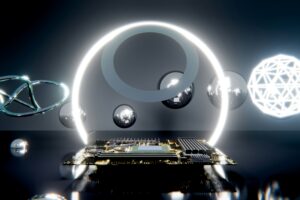
Suggested Featured Image Idea: A clean, modern illustration of a quantum computing chip inside a cryogenic chamber, with abstract glowing qubit connections forming a subtle network pattern — scientific but not overly technical.
Suggested Graph/Infographic Idea: A simple progress-bar style graphic showing the gap between today’s logical qubit counts (~90-100) and the estimated ~4,000 logical qubits needed for cryptographically relevant computation, based on the figures above.
3 Internal Link Suggestions:
- Anchor Text: “AI-powered cybersecurity: how AI is fighting new threats” — Related Topic: A connected piece on post-quantum cryptography and preparing security systems for future quantum risk.
- Anchor Text: “AI supercomputers: why massive computing power is driving the AI revolution” — Related Topic: A comparison piece on classical AI computing infrastructure versus quantum computing’s different approach to processing power.
- Anchor Text: “top 10 AI trends in 2026 you should know about” — Related Topic: A broader roundup situating quantum computing progress alongside other major 2026 technology trends.